

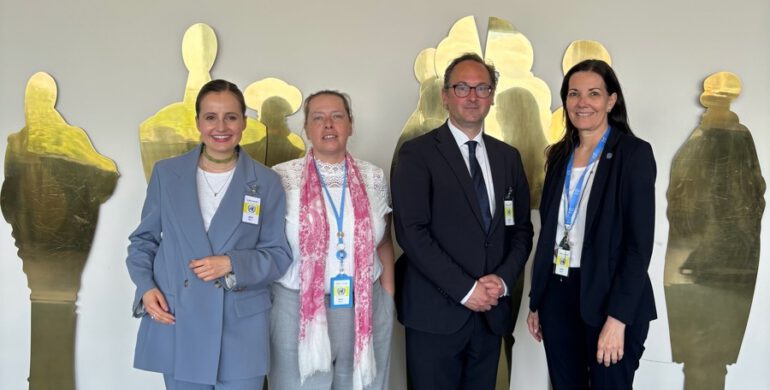
“Family Policy in Sweden, Austria and Hungary: Demographic Challenges, Gender Equality and Traditional Family Models”
Andreas Minnich and Helena Hierzer discussed family policy in different countries, focusing on gender equality, women’s employment, and demographic trends.
Andreas Minnich is a Member of the Austrian Parliament, Vice-Chair and member of the Foreign Affairs Committee.
Helena Hierzer is a parliamentary advisor to a member of the Austrian Parliament. At the same time, she is pursuing a Master’s degree in International Management, with her thesis focusing on family–career policy models in Austria and Sweden.
The talk focused on Sweden, Austria and Hungary, as these three countries represent different family-policy models.
Sweden follows a model that strongly supports women’s participation in the labour market and promotes shared childcare responsibilities between mothers and fathers.
Austria combines financial family benefits with increasing investment in childcare infrastructure.
Hungary follows a more traditional and conservative family-policy model, supporting mothers more strongly in staying at home with children through financial incentives and tax benefits.
A central topic was how parental leave influences the division of childcare between mothers and fathers.
In Sweden, parental leave is designed to encourage both parents to take responsibility for childcare. This strengthens gender equality and supports women’s economic independence. In Austria and Hungary, childcare responsibilities are still more often carried by mothers, which can lead to longer career interruptions and lower long-term income for women.
Another important point was the role of childcare. Access to affordable, reliable and high-quality childcare is essential for enabling parents, especially women, to return to the labour market. Andreas Minnich emphasized that Austria has invested significantly in kindergartens and family-friendlyinfrastructure. The expansion of childcare from the second year of life isintended to support women’s re-entry into employment and improve the balance between family and work.
The discussion also included the idea of “Oma-Karenz”, meaning a form of grandparental leave or stronger support for grandparents who help with childcare. Grandparents often play an essential role in family life, especially when parents return to work or when childcare places are limited. Recognising this contribution could relieve parents, support women’s employment and strengthen intergenerational solidarity.
The talk also addressed demographic developments. Sweden, Austria and Hungary all face low fertility rates and ageing populations. According to data published by Statista in April 2026, Austria has a fertility rate of around 1.31 children per woman, Hungary around 1.41, and Sweden around 1.43. These figures show that, despite different family-policy approaches, all three countries face similar demographic challenges.
A key conclusion was that financial support alone is not enough to solve Europe’s demographic crisis.
Families also need flexible working models, home office options, reliable childcare, better infrastructure in rural areas and a more family-friendly social culture.
Overall, the talk showed that modern family policy must combine financial support with structural reforms. A successful family-policy model should promote gender equality, strengthen childcare infrastructure, support fathers’ involvement, recognise unpaid care work and create real freedom of choice for families.
Sweden currently aligns most closely with a dual-earner and gender-equality-oriented model, while Austria is moving towards stronger childcare support and Hungary remains more traditionally oriented.
